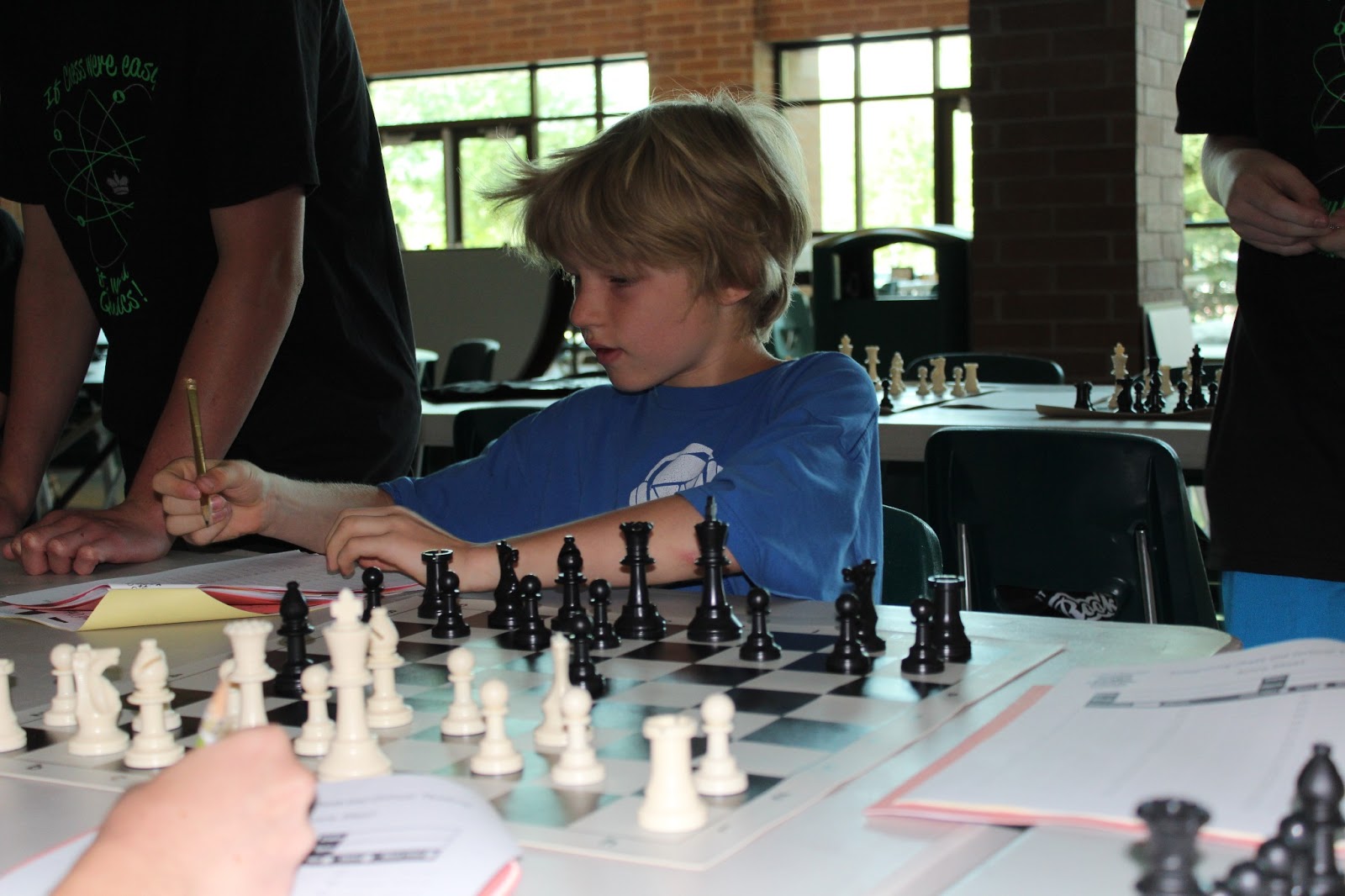
The BCSD Chess Club sponsored its first chess camp for elementary and middle school aged kids earlier this summer (June 10 - 14th) and it was met with great success. Sixteen players attended and seven high school club members served as counselors. The week consisted of daily instruction, play, mind games, and other lessons culminated in a tournament and a simul on Friday. Here is the rigorous schedule:
Time
|
Monday
|
Tuesday
|
Wednesday
|
Thursday
|
Friday
|
9:00 – 9:10
|
|
Think, Pair,
Share
|
Think, Pair,
Share
|
Think, Pair,
Share
|
|
9 – 9:30 am
|
Counselors
and Campers play (evaluations)
·
Piece Value
·
Castling
·
Name that Square
|
Counselors
and Campers play (evaluations)
·
En Passant
·
scorekeeping
|
Counselors
and Campers play (evaluations)
·
scorekeeping
|
Counselors
and Campers play (evaluations)
·
evaluate a game
|
Simul
|
9:30 – 9:50am
|
Mini-Lesson:
·
Bear Hugs
·
Ladder
·
Notation
|
Mini-Lesson:
·
Bad Openings
·
Pins, Forks, skewers, discovery
·
Philidor’s Defense
·
Scotch Opening
|
Mini-Lesson:
·
Ruy Lopez Opening
·
French Defense
·
Pawn Structures
·
Square of the Pawn
|
Mini-Lesson:
·
Game of the Century
|
Simul
|
9:50 – 10:15
am
|
Play Practice
|
Play
Practice
|
Play
Practice
|
Play
Practice
|
Tournament
|
10:15 –
10:30 am
|
Memory
Boards
|
Memory
Boards
|
Memory
Boards
|
Memory
Boards
|
Tournament
|
10:30 –
10:45 am
|
Break
|
Break
|
Break
|
Break
|
Tournament
|
10:45 –
11:10 am
|
Opening
Lesson:
·
Ideal Opening
·
Fried Liver
·
Scholar’s Mate
|
Middlegame
Lesson:
·
Glowing Squares
·
Attackers and Defenders
|
Endgame
Lesson:
·
Stalemates
·
Draws
·
Promoting
|
Aftergame
Lesson:
·
Critical moments
·
analysis
|
Tournament
|
11:10 –
11:30 am
|
Play
Practice
|
Play
Practice
|
Play
Practice
|
Play
Practice
|
Tournament
|
11:30 –
12:00 pm
|
|
Chesskid.com
Pawn Mowers
|
Pawn Mowers
|
Scavenger
Hunt
|
Awards
|
12:00 –
12:30 pm
|
Lunch
|
Lunch
|
Lunch
|
|
Parent
pickup
|
12:30
|
Think, Pair,
Share
|
Think, Pair,
Share
|
Think, Pair,
Share
|
Think, Pair,
Share
|
|
12:30 – 1:50
pm
|
Stations:
·
blitz
·
bughouse
·
giant chess
·
take away
·
snap electronics
·
Normal Chess
|
Stations:
·
blitz
·
bughouse
·
giant chess
·
take away
·
snap electronics
·
Four Way Chess
·
Chesskid.com
|
Stations:
·
blitz
·
bughouse
·
giant chess
·
take away
·
snap electronics
·
Four Way Chess
·
Ping Pong/Foosball
·
Long chess
|
Stations:
·
blitz
·
bughouse
·
giant chess
·
take away
·
Four Way Chess
·
Long chess
·
Ping Pong/Foosball
|
|
2:00 pm
|
Parent
pickup
|
Parent
pickup
|
Parent
pickup
|
Parent
pickup
|
|
 |
| Desmond shares some knowledge with campers |
 |
| Dylan shows Otto how to record a move. |
Each day began with a chess puzzle displayed on the big screen with a short discussion about the solutions. Then each counselor worked with a small group of players teaching them what ever they wanted, or they played each of the kids and monitored their abilities. Each student received a
basic skill evaluation that each counselor was responsible for helping the students complete by the end of the week.
Integrating Chess and Critical Thinking
Basic Skills Checklist
NAME:_________________________________
DATE PASSED:
________ 1. DEMONSTRATE
HOW THE PAWN MOVES. P
________ 2. DEMONSTRATE
HOW THE KNIGHT MOVES.N
________ 3. DEMONSTRATE
HOW THE BISHOP MOVES.
B
________ 4. DEMONSTRATE
HOW THE QUEEN MOVES.
Q
________ 5. DEMONSTRATE
HOW THE KING MOVES. K
________ 6. DEMONSTRATE
KING-SIDE
CASTLING
________ 7. DEMONSTRATE
QUEEN-SIDE
CASTLING
________ 8. STATE
THE RELATIVE VALUE OF THE PIECES.
________ 9. EXPLAIN
THE TERMS RANK, FILE, DIAGONAL.
________10.EXPLAIN
THE TERM CENTER.
________11.SHOW
THE CENTER SQUARES.
________12.EXPLAIN
WHAT IS MEANT BY THE TERM DEVELOPMENT.
________13.PLACE
A CHECK ON THE CHESSBOARD.
________14.PLACE
A CHECKMATE ON THE CHESSBOARD.
________15.PLACE
A STALEMATE ON THE CHESSBOARD—EXPLAIN.
________16.EXPLAIN
THE TOUCH MOVE RULE.
________17.DEMONSTRATE
A PIN.
________18.DEMONSTRATE
A FORK.
________19.DEMONSTRATE
A SKEWER.
________20.SET
UP A BACK-RANK MATE ON THE CHESSBOARD.
________21.DEMONSTRATE
A DISCOVERED ATTACK.
________22.EXPLAIN
THE 3 WAYS TO GET OUT OF CHECK.
________23.BASICALLY
WHEN DOES THE MIDDLE-GAME BEGIN IN CHESS.
________24.BASICALLY
WHEN DOES THE END-GAME BEGIN IN CHESS.
________25.SHOW
THE FOOL’S
MATE AND EXPLAIN WHY IT IS CALLED A FOOL’S
MATE.
________26.NAME
3 BASIC GUIDELINES/RULES
FOR OPENING A CHESS GAME.
________27.NAME
2 BASIC GUIDELINES/RULES
USED IN THE ENDING OF A CHESS GAME.
________28.CHECKMATE
USING A KING AND QUEEN
AGAINST A LONE KING.
________29.CHECKMATE
USING A KING AND TWO ROOKS
AGAINST A LONE KING.
________30.SHOW
HOW TO PREVENT GETTING MATED BY THE SCHOLAR’S
MATE
 |
| Mat'ka shows a surprising move. |
The camp was a great deal for $105. It included lot's of learning and fun, but also included a morning snack, lunch, and also some tangibles like a tournament chess set, carrying backpack, a daily problem and lesson packet, a chess rage t-shirt, a medal, and a photograph certificate. We also had a watermelon scavenger hunt, and played ping-pong and foosball during some free time.
 |
| I am showing Sarah how a chess engine works to help your game. |
It was clear that all of the kids loved the camp, and they wanted it to continue or asked for another camp before the end of summer. Each day I was surprised by e-mails or phone messages left by the parents that praised the camp and the counselors.
More will follow . . .
 |
| Our outstanding counselors (Left to right: Victor Saldivia, Andre Murphy, Anna Murphy, Riley Clark, Desmond Porth, Mat'ka Last, Dylan Porth - Tanya Wilkerson missed picture day!) |